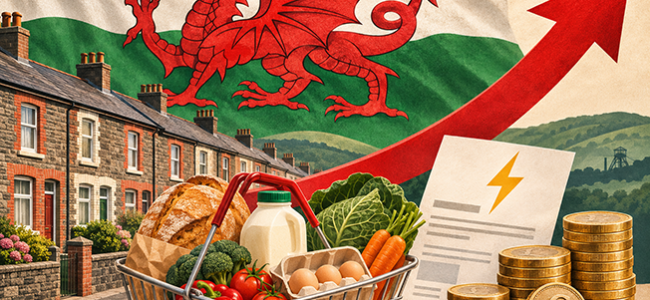

The Bank of England has increased interest rates to 4%, adding further pressure to households already struggling with rising energy, food and transport costs.
The decision comes as the Bank warns that UK inflation could approach 5% in 2027, driven largely by the continuing impact of the conflict in the Middle East on global energy prices.
For households across Wales, the combination of higher prices and more expensive borrowing could mean hundreds, or potentially thousands, of pounds in additional annual expenditure.
And while inflation and interest rates are set at a UK level, some characteristics of the Welsh economy mean the impact could be particularly difficult for communities already facing financial pressures.
Why have interest rates increased?
The Bank of England has raised its main interest rate from 3.75% to 4% in an attempt to prevent rising energy prices from creating a longer-lasting inflation problem.
Inflation measures how quickly prices are increasing. The Bank’s target is 2%, but the latest official figures show UK consumer price inflation running at 3.5% in September.
The Bank now expects inflation to approach 5% during 2027.
Much of the increase is linked to higher oil and gas prices following the conflict in the Middle East.
According to the Bank’s latest assessment, household energy and motor-fuel prices account for approximately 60% of the amount by which September inflation exceeded its 2% target.
That represents around 0.9 percentage points of the 3.5% inflation rate.
However, higher energy costs can also affect the prices of other goods and services, including food, manufacturing and transport.
The Bank is particularly concerned that businesses could pass rising costs on to customers and that workers could seek higher wages to compensate for the increased cost of living.
Higher interest rates are intended to reduce spending and borrowing, limiting the risk of these price increases becoming permanent.
How much could Welsh households pay?
The impact will vary considerably depending on household income, housing costs, energy consumption and reliance on private transport.
Consider a household with a £150,000 repayment mortgage, one petrol car and typical domestic energy consumption.
If household energy bills increase from £1,723 to £2,150 annually, that represents an additional £427.
A driver covering 12,000 miles annually in a car averaging 40 miles per gallon would pay approximately £409 more each year if petrol prices increased by 30p per litre.
Meanwhile, a household refinancing a £150,000 mortgage over 20 years at 4.5%, rather than 3.5%, would face an increase of approximately £924 annually.
Together, those changes could increase household expenditure by approximately £1,760 a year, or £147 a month.
This is an illustrative example rather than a forecast for the average Welsh household. Not every household will experience these increases, and the full impact of higher interest rates depends on individual mortgage arrangements.
Nevertheless, it demonstrates how several relatively modest increases in essential costs can combine to place considerable pressure on household finances.
Why could Wales be particularly vulnerable?
Wales has historically experienced lower average earnings and higher levels of relative income poverty than many other parts of the UK.
That means increases in essential expenditure can consume a greater proportion of household income.
A £400 increase in annual energy costs, for example, represents a much greater burden for someone earning £22,000 than for someone earning £50,000.
Housing also presents challenges.
Wales has a substantial number of older properties, including traditional stone-built houses that can be expensive to heat and difficult to insulate.
Some rural households depend on heating oil or LPG rather than mains gas. These households can be particularly exposed to changes in wholesale energy prices.
Transport is another important consideration.
In rural communities across Wales, access to employment, education, healthcare and essential services frequently depends on having a car.
With petrol costing approximately 173p per litre and diesel approaching £2 per litre, transport represents a substantial household expense.
Filling a 50-litre petrol tank costs around £86.50.
For families travelling considerable distances to work or access services, higher fuel costs can quickly add up.
What about mortgages and rents?
The Bank of England’s decision does not mean that every mortgage holder will immediately pay more.
Borrowers with fixed-rate mortgages will generally see no change until their existing agreement expires.
However, households with tracker or variable-rate mortgages may experience increases sooner.
Those refinancing mortgages during 2027 could also face substantially higher borrowing costs than anticipated before the energy crisis.
In February, financial markets had expected Bank Rate to move towards approximately 3.25%.
Instead, it has now reached 4%, with further increases possible.
The Bank has warned that average annual mortgage payments could be approximately £1,500 higher by the end of 2029 than previously projected, although the impact on individual households will vary.
Private renters may also experience indirect effects if landlords face higher mortgage costs, although rent increases are influenced by several factors, including local demand and tenancy regulations.
What could this mean for Welsh businesses and jobs?
The consequences extend beyond household budgets.
Higher energy prices increase operating costs for businesses, while higher interest rates make borrowing and investment more expensive.
Manufacturing businesses, particularly those dependent on energy-intensive processes, face higher production costs.
Agricultural businesses are exposed to increased expenditure on fuel, fertiliser, heating and transport.
Retailers, restaurants and hospitality businesses face a different challenge: rising operating costs at the same time as customers have less money available to spend.
This could be particularly significant for Welsh towns and communities where independent businesses depend heavily on local customers.
When households reduce discretionary spending, the effects can spread through the local economy.
Businesses may delay investment, reduce recruitment or, in more difficult circumstances, cut jobs.
The danger is a prolonged period of weak economic growth alongside above-target inflation — a combination commonly described as stagflation.
What can the Welsh Government do?
The Welsh Government has no control over Bank of England interest rates or global oil and gas prices.
However, it does have powers and programmes that could help reduce the impact on households and businesses.
These include improving home energy efficiency, supporting public transport, providing targeted assistance to vulnerable households and helping businesses reduce their energy consumption.
There is also a significant challenge for Welsh public services.
Higher inflation increases the cost of delivering healthcare, education, social care, transport and other services.
Even where budgets remain unchanged in cash terms, rising costs mean that the same amount of money purchases fewer goods and services.
This could increase pressure on the Welsh Government and local authorities at a time when demand for public support may also be rising.
Will interest rates continue rising?
Financial markets have been anticipating further increases, although there remains considerable uncertainty about how far rates will rise.
The Bank of England’s immediate concern is whether higher energy prices begin to influence wage settlements and prices across the wider economy.
If oil and gas prices continue falling, inflationary pressures could ease and reduce the need for further interest-rate increases.
However, if energy costs remain elevated throughout winter and into 2027, inflation could stay above target for longer.
Higher interest rates also create a difficult balancing act.
While they can help reduce inflation, they also increase borrowing costs and discourage spending and investment, potentially weakening economic growth.
The Bank must therefore weigh the risk of persistent inflation against the possibility of causing unnecessary additional damage to the economy.
Inflation falling does not mean prices falling
There is another important distinction for households.
Even if the Bank succeeds in bringing inflation back to its 2% target, this does not mean prices will return to their previous levels.
If something costs £100 and its price increases by 5%, it costs £105.
If inflation then falls to 2%, the price increases again to £107.10.
Prices are still rising, just more slowly.
For Welsh households, the real test will therefore be whether wages, pensions and benefits increase sufficiently to restore the purchasing power lost through successive periods of inflation.
Why this matters
The Bank of England’s latest decision confirms how significantly the UK’s economic outlook has changed since February.
Instead of inflation returning towards 2% and interest rates falling, households now face the prospect of inflation approaching 5% and borrowing costs remaining higher for longer.
For Wales, where lower incomes, rural transport dependency and older housing can make essential costs particularly burdensome, the consequences could be substantial.
The immediate concern is not simply the headline inflation figure or the Bank’s interest-rate decision.
It is the combined effect on household budgets, local businesses, employment and public services.
And even when inflation eventually falls, the financial consequences of this latest energy shock could be felt by Welsh households for years to come.
Sources: Bank of England, November 2026 Monetary Policy Report and Monetary Policy Committee decision; Office for National Statistics, September 2026 Consumer Price Inflation; Department for Energy Security and Net Zero, Weekly Road Fuel Prices; Ofgem energy price cap information.
Note: The household cost example is illustrative. Future energy bills, mortgage costs and interest rates are projections rather than confirmed outcomes.