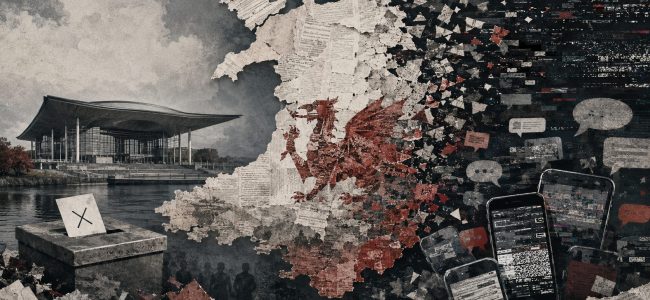

How the decline of independent Welsh journalism is weakening democratic accountability and why public investment is now essential.
Democracy in Wales extends far beyond the fundamental right to vote. A fully functioning democracy relies on its citizens being able to access reliable information about the Wales they live in, the decisions being made in their name, and the choices available to them at election time. In Wales, that basic democratic infrastructure is under serious threat. The decline of high-quality, independent, public-interest news is not simply a media industry problem. It is a democratic problem.
Wales, as a devolved nation, has its own parliament, government, laws, public services and political choices. Decisions made in the Senedd shape the Welsh NHS, schools, transport, housing, farming, culture, the Welsh language, economic development and local government. Yet far too many people in Wales still receive most of their political information through a UK media lens, where Welsh institutions are often marginal, misunderstood or ignored altogether.
This matters because democracy in Wales asks citizens to make choices about Welsh political realities. Voters are expected to judge the performance of the Welsh Government, understand the role of the Senedd and how it functions, compare party policies, and decide who should govern. But if the news they can access does not explain Welsh devolution clearly, does not scrutinise Welsh decision-making properly, and does not connect national policy to people’s everyday lives, then citizens are being asked to participate in democracy without the tools they need.
The problem is especially acute at the local and community level. Across the UK, local journalism has been weakened by collapsing print circulation, falling advertising revenue, newsroom cuts and the closure of local titles. In Wales, where geography, language, poverty, rurality and uneven digital access already create barriers to shared civic understanding, the consequences are profound. When independent reporters are no longer present in council chambers, health board meetings, courts, community campaigns or local public bodies, decisions take place with less scrutiny. Mistakes go unnoticed. Promises go untested. Power becomes more comfortable.
The decline of local news also creates a vacuum. That vacuum is increasingly filled by social media groups, rumour, partisan pages, anonymous accounts, influencers and algorithmically driven content. These spaces can be useful, immediate and community-minded, but they are not a substitute for public interest journalism. A Facebook group can tell people that a road in Blaengarw is closed; what it cannot do is reliably replace trained reporters checking facts, questioning officials, explaining context and correcting false claims.
This is where the democratic danger deepens. The Social Market Foundation report No News is Bad News highlights the link between weak local news ecosystems and misinformation. Where trusted local media is absent or under-resourced, false information has more space to grow. Elections, planning disputes, immigration, crime, health services and council decisions can all become fertile ground for misleading claims. In places where people already feel ignored or alienated, misinformation can spread quickly because it appears to offer simple explanations for complex problems.
Wales is vulnerable to this. Our politics is already more complex than much of the UK media system allows. Responsibility is split between Westminster, Welsh Government, local authorities, health boards, regulators and other public bodies. Without strong Welsh public interest journalism, confusion becomes easy to exploit. A failure caused by Westminster funding decisions may be blamed on Cardiff Bay. A devolved responsibility may be wrongly attributed to London. A local council decision may be turned into a national conspiracy. In that fog, democratic accountability breaks down.
Young people are particularly exposed. News consumption has shifted rapidly towards social media, video platforms and, increasingly, AI tools. Younger audiences are less likely to build regular habits around newspapers, television bulletins or news websites. If Welsh public interest journalism is not visible in the spaces where young people actually spend time — TikTok, Instagram, YouTube, WhatsApp, podcasts and short-form video — then a whole generation may come of age without a clear understanding of Welsh democracy.
That should worry anyone who cares about the future of Wales. The next Senedd elections will be fought in a noisy, fragmented and highly contested information environment, one that follows a UK General Election. Wales will have, potentially, another new voting system amidst an increasingly volatile political landscape. At a time when citizens need more explanation, more scrutiny and more trusted Welsh information, the public interest news ecosystem will be weaker than it should be.
Public service broadcasters remain vital, but they cannot and should not carry the whole burden. Nor should Wales rely solely on commercial media groups whose business models are driven by scale, clicks, advertising and centralised production. Democracy needs a mixed ecology: strong public service broadcasting, independent local journalism, community media, investigative reporting, civic explainers, youth-focused news, and journalism rooted in the lived experience of Welsh communities.
That requires funding and investment. It is no longer credible to say that the market alone will provide the news Wales needs. The market has already shown us what happens: local titles close, reporters disappear, coverage thins out, and communities are left with less reliable information. If public interest news is part of democratic infrastructure, then it should be treated as such.
Welsh Government should therefore establish a long-term public interest news investment fund for Wales. This should support independent journalism, local reporting, community newsrooms, bilingual content, youth news services, investigative work and media literacy programs across all ages. Funding should be transparent, at arm’s length from government, editorially independent and open to a range of providers, including co-operatives, social enterprises, community broadcasters and independent publishers.
Investment should also prioritise news deserts: communities where public bodies are under-scrutinised, and citizens have little access to reliable local information. Wales needs reporters covering councils, courts, health boards, schools, transport decisions, planning, housing, climate adaptation and the everyday workings of devolved government. It also needs modern formats that reach people where they are, not where the media industry wishes they still were.
This is not about funding favourable coverage. It is about funding democratic capacity. A confident Welsh democracy should welcome scrutiny, challenge and informed debate. Citizens cannot hold power to account if they do not know where power sits, what it is doing, or how decisions affect their lives.
The choice is clear. Wales can allow the Welsh public interest news ecosystem to wither, leaving citizens more vulnerable to misinformation, disengagement and democratic confusion. Or it can invest in the information infrastructure that a modern devolved nation like Wales needs.
If we want Welsh citizens to be informed, educated and empowered, then quality independent public interest news must be treated not as a luxury, but as a democratic necessity.