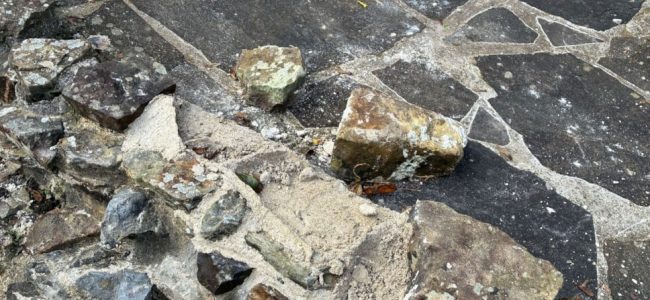

A year’s worth of specialist restoration work at Haverfordwest Priory has been severely damaged in what heritage officials believe was a deliberate act of vandalism.
Cadw, the Welsh Government’s historic environment service, says extensive conservation work carried out over the past 12 months has been damaged in a matter of hours, prompting renewed calls for the public to report heritage crime and antisocial behaviour at historic sites across Wales.
The restoration programme at Haverfordwest Priory in Pembrokeshire involved Cadw’s specially trained stonemasons and contractors undertaking extensive masonry repairs to protect the historic remains and improve the site for visitors.
The work, which cost just under £50,000, was intended to secure the long-term future of the priory and ensure that it remained a safe and accessible place for local residents and visitors.
However, Cadw says much of that work has now been destroyed.
The full financial cost of the damage has yet to be established, and it is not yet clear how much of the restoration will need to be repeated.
A year’s work undone in hours
The damage has affected not only the historic structure but also the people who have worked to preserve it.
Cadw says the vandalism has left volunteers and specialist craftspeople disheartened, including a long-serving volunteer gardener and the stonemasons responsible for the conservation programme.
Fleur Gordon, Head of Properties in Care at Cadw, described the incident as particularly distressing.
“It is with a heavy heart that we have seen significant antisocial behaviour and vandalism at Haverfordwest Priory,” she said.
“Effectively, a year’s work within the cloisters has been affected and specialist conservation undone in what appears to have been a concerted and determined act, rather than a careless accident.”
Her comments suggest that Cadw believes the damage was deliberate rather than the result of accidental disturbance or ordinary wear and tear.
The organisation has not provided details of any suspects or arrests in the statement.
The wider cost of heritage crime
Although the immediate financial impact is substantial, Cadw says the consequences extend beyond the cost of repairing damaged stonework.
Conservation of historic buildings requires specialist skills, careful planning and considerable time. Where recently completed work is destroyed, public money and professional resources may have to be redirected towards repeating repairs rather than preserving other threatened sites.
The incident also raises questions about the protection of historic monuments that are accessible to the public, particularly where sites rely on volunteers and limited conservation budgets.
For organisations responsible for maintaining Wales’s historic environment, vandalism creates an additional financial burden at a time when historic buildings and archaeological remains require continuing maintenance.
The loss of volunteer effort can be equally significant. Community involvement often plays an important role in caring for historic sites, maintaining their surroundings and making them accessible to visitors.
Cadw has warned that incidents of this kind can discourage those who dedicate their time to protecting Wales’s heritage.
What constitutes heritage crime?
Heritage crime is not limited to graffiti or the deliberate destruction of buildings.
It can include theft of historic materials, arson, unauthorised alterations to protected structures, illegal metal detecting, damage to archaeological remains and off-road driving across sensitive historic landscapes.
Removing or rearranging archaeological material can also cause lasting damage by disturbing the evidence that helps historians and archaeologists understand how a site was used.
In some cases, damage to historic fabric cannot simply be reversed. Even where repairs are possible, original material and archaeological information may be permanently lost.
Cadw is using the Haverfordwest incident to encourage greater public awareness of these offences during the October half-term holiday, when historic sites across Wales may experience increased visitor numbers.
Public urged to report incidents
Fleur Gordon said the damage at Haverfordwest was especially frustrating because of the resources invested in protecting historic buildings for future generations.
“It is frustrating to see such mindless vandalism,” she said.
“Cadw spends much time, effort and money rebuilding beloved historic buildings, especially so for our next generations who’ll be visiting sites this half-term.”
She urged anyone witnessing similar incidents to report them to the police.
The appeal comes as Cadw seeks to highlight the importance of protecting historic places, not only as tourist attractions but as public assets that preserve the history of Welsh communities.
The organisation has not yet confirmed when repair work at Haverfordwest Priory might begin or whether additional security measures will be introduced.
Why it matters
The destruction of conservation work at Haverfordwest Priory highlights a wider challenge in protecting Wales’s historic environment.
Nearly £50,000 has recently been spent on restoring the site, but the extent of the financial loss remains uncertain. Any requirement to repeat the work could divert resources from other conservation priorities.
There are also questions about whether vulnerable historic sites have sufficient protection against deliberate damage, particularly where they are freely accessible.
For the local community, the damage represents the loss of work undertaken to preserve an important historic landmark. For Cadw, it raises the wider issue of how Wales can protect its historic places while keeping them open and accessible to the public.