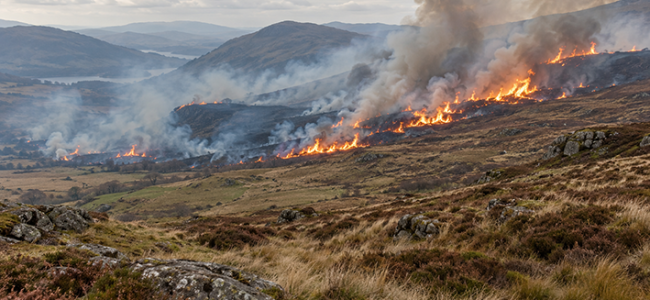

The Welsh Government has commissioned a review of the code governing controlled heather and grass burning, a land management practice with implications for farming, biodiversity, carbon storage and wildfire prevention.
The Cabinet Minister for Rural Resilience and Sustainability approved the review of the Heather and Grass Burning Code for Wales 2008 on 27 October.
The decision comes amid continuing concern about the management of upland habitats and the risk of uncontrolled vegetation fires.
However, the Government’s published decision does not specify the review’s terms of reference or indicate whether changes to legislation are being considered.
Why is vegetation burned?
Controlled burning has historically been used to manage vegetation on some upland and agricultural land.
It can be intended to remove older growth, encourage new vegetation and manage habitats used for grazing.
Some land managers also use carefully planned burning as part of attempts to reduce combustible vegetation.
However, the environmental consequences depend on the location, frequency, timing and method used.
Concerns about biodiversity and carbon
Burning can damage sensitive habitats when it is poorly managed or undertaken in unsuitable conditions.
Particular concerns arise around peatlands, where vegetation and underlying soils can store substantial amounts of carbon.
Damage to peatland can affect carbon storage, water regulation and habitat quality.
There are also questions about the effects of repeated burning on wildlife, vegetation structure and soil condition.
These concerns must be balanced against the practical challenges faced by farmers and land managers maintaining upland landscapes.
The wildfire question
Wildfires can cause serious damage to habitats, property and infrastructure.
Climate conditions, vegetation management and human activity can all influence wildfire risk.
The relationship between controlled burning and wildfire prevention is complex.
Some forms of vegetation management may reduce fuel loads, while burning undertaken in inappropriate conditions can itself cause fires or damage sensitive environments.
A review of the code provides an opportunity to examine current evidence and assess whether existing guidance remains appropriate.
What could change?
The Government has commissioned a review, not announced new restrictions.
Possible subjects for examination include permitted burning periods, environmental safeguards, training, notification requirements and the protection of sensitive habitats.
These are potential areas for scrutiny rather than confirmed proposals.
Any subsequent policy changes would need to be assessed against their effects on land management, agriculture, biodiversity and fire prevention.
Why it matters
The review could influence how substantial areas of Welsh upland and agricultural land are managed.
It also provides an opportunity to consider whether existing guidance adequately reflects current scientific evidence and changing environmental conditions.
The key next step is publication of the review’s scope, timetable and arrangements for involving farmers, conservation organisations, fire services and other interested parties.