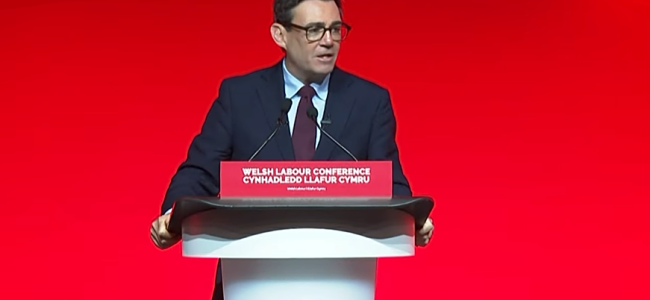

The Prime Minister used his first Welsh Labour conference speech to promise a stronger Wales within the UK, further devolution and a renewed industrial economy. But beyond one potentially significant offer on employment support, there was little detail about new powers, funding or delivery.
Prime Minister Andy Burnham has offered to explore the full devolution of employment support to Wales, promised closer cooperation with the Welsh Government and committed to removing standing charges from domestic gas bills next year.
Addressing Welsh Labour’s conference in Llandudno on Saturday, Burnham outlined his ambition for a reindustrialised Wales, with better jobs, stronger communities and greater local control over economic decisions.
But while Wales featured prominently throughout the speech, much of the policy content concerned measures being developed for the UK as a whole.
And despite repeated commitments to take power away from Westminster, Burnham offered no timetable for a new Welsh devolution settlement, no specific additional funding for Welsh public services and no commitment to transfer powers over justice, policing, broadcasting or the Crown Estate.
The biggest offer: control over employment support
The most substantial Wales-specific proposal concerned employment support — the programmes intended to help unemployed and economically inactive people find work.
Burnham said he wanted to open discussions with the First Minister about transferring greater responsibility for these services to Wales, potentially including full devolution.
He confirmed that he had asked Number 10 North to explore the proposal with the Welsh Government.
This could be significant.
Employment support currently involves a mixture of reserved UK responsibilities and devolved Welsh programmes. Greater Welsh control could allow employment services to be more closely integrated with education, skills, health and local economic development.
Burnham linked the proposal particularly to young people, technical education and stronger connections between training and local employers.
However, his wording was conditional. He said the offer was on the table and that agreement would have to be reached.
There was no announcement of which programmes would transfer, how they would be funded, when the changes might happen or whether Wales would receive the full resources currently associated with those services.
It was an offer to negotiate further devolution, not a completed agreement to transfer powers.
More powers for councils — but what about the Senedd?
Burnham’s broader constitutional message was that devolution should go beyond Cardiff Bay and reach communities throughout Wales.
Drawing on his experience as Mayor of Greater Manchester, he argued for strengthening Welsh councils and regional partnerships.
He also acknowledged that Wales needed its own approach rather than simply adopting the English model.
Importantly, he said further devolution should work through the Senedd rather than bypass it.
That raises questions about what he means by additional powers for local authorities and regional bodies, particularly where those powers would currently be exercised by the Welsh Government.
The speech did not identify which responsibilities would be transferred, whether new legislation would be needed or what financial resources would accompany them.
Nor did Burnham address some of the most prominent outstanding Welsh constitutional demands, including control over policing and justice, broadcasting or the Crown Estate.
His approach was therefore an endorsement of further devolution in principle, with one identifiable proposal on employment support, rather than a comprehensive new settlement for Wales.
A promise on energy bills
The clearest new household commitment was Burnham’s announcement that the UK Government would remove standing charges from domestic gas bills in the new year.
He said the change would benefit households throughout Wales.
Unlike his employment-support proposal, this was presented as a definite policy commitment.
However, the speech did not explain how the standing charges would be removed, how the associated costs would be recovered or whether other elements of gas bills might change.
The distinction matters because removing a standing charge does not necessarily mean that the entire amount currently collected through it will disappear from the energy system.
Burnham also highlighted measures already announced or introduced by his government, including removing VAT from electricity bills and supporting a £100 council tax rebate.
He welcomed the Welsh Government’s decision to use funding made available through the UK package to provide equivalent support in Wales.
These were relevant to Welsh households, but they were not additional Wales-specific announcements made at the conference.
A new UK–EU deal for Welsh farmers and exporters?
A substantial section of the speech focused on Burnham’s ambition to improve the UK’s trading relationship with the European Union.
Ahead of a forthcoming UK–EU summit, he promised to pursue a new agreement covering food and farming.
He argued that reducing trade barriers could lower costs for businesses and consumers, identifying Welsh lamb, shellfish and other agricultural exports as potential beneficiaries.
Burnham also suggested that a successful agreement could increase UK economic output by up to 0.4%.
That figure was presented as a potential UK-wide benefit, not a forecast of additional growth in Wales.
For Welsh producers facing export certification requirements and other post-Brexit trading costs, an agreement could be important.
But no agreement had been secured, and the speech did not provide details of its proposed terms or any specific financial benefits for Welsh businesses.
Reindustrialising Wales
Burnham placed industrial renewal at the centre of his long-term vision.
He referred to advanced manufacturing and nuclear opportunities in North Wales, semiconductor production in South East Wales, floating offshore wind in the Celtic Sea and agricultural innovation in Mid Wales.
He also discussed his visit to the Port Talbot steelworks and the transition towards electric arc furnace steelmaking.
His argument was that Wales should not repeat the experience of industrial communities that lost major employers without receiving sufficient support to develop replacement industries.
The theme was closely connected to his personal account of the Aberfan disaster and his work with the Hillsborough families.
But the speech contained no new Wales-specific industrial investment package, no new funding commitment for Port Talbot and no quantified targets for employment or regional growth.
It was a statement of economic direction rather than a detailed industrial programme.
How much of the speech was really about Wales?
The speech was unmistakably directed at a Welsh audience, but that does not mean all its policy proposals were specifically designed for Wales.
Its content can be divided into three broad categories.
Welsh politics and identity: Burnham discussed Aberfan, the industrial history of Wales, the achievements of previous Welsh Labour governments, Labour’s defeat in the Senedd election and the party’s plans to rebuild.
UK-wide policy: He devoted substantial attention to energy bills, council tax support, workplace savings, Brexit, UK–EU relations, industrial strategy and opportunities for young people. These policies would affect Wales, but most were not Welsh-specific.
New Welsh commitments: The clearest proposals concerned exploring full devolution of employment support, strengthening councils and regional partnerships, and improving cooperation between the UK and Welsh Governments.
On a thematic reading, roughly half the speech was concerned with UK-wide policy, wider British political arguments or shared economic challenges, even where Welsh examples were used. This is an approximate editorial assessment rather than a precise timed or word-count measurement.
The remainder was primarily devoted to Welsh history, Labour’s political position in Wales, devolution and the relationship between the two governments.
The more revealing distinction is between the amount of time spent discussing Wales and the amount of new policy offered specifically to Wales.
The former was substantial. The latter was relatively limited.
What did Burnham actually promise Wales?
| Commitment | What was offered | Status |
|---|---|---|
| Employment support | Explore potentially full devolution to Wales | Negotiation proposed |
| Local government powers | Strengthen Welsh councils and regional partnerships | Broad policy intention |
| UK–Welsh Government relations | Closer cooperation on economic development and regional empowerment | Political commitment |
| Gas standing charges | Remove them in the new year | UK-wide policy promise |
| EU food and farming trade | Seek a new agreement to reduce barriers | Negotiating objective |
| Industrial renewal | Support reindustrialisation and good jobs across Wales | Long-term ambition |
| Additional Wales-only funding | No new quantified allocation announced | No specific commitment |
| Justice, policing, broadcasting or Crown Estate devolution | Not addressed | No commitment |
A political speech as much as a policy speech
Burnham was speaking to a Welsh Labour Party attempting to rebuild after losing power in Cardiff Bay.
He acknowledged that Labour had stopped listening sufficiently to voters and had lost sight of some of the principles behind devolution.
His response was to promise a closer partnership between UK Labour and Welsh Labour, while offering to work with the current Welsh Government.
He also presented his preferred constitutional future as a stronger Wales within a more decentralised United Kingdom.
This was an important political argument, but it should not be confused with the announcement of a new constitutional settlement.
Burnham’s central proposition was that Wales could gain more influence, stronger communities and renewed economic opportunity through cooperation within the UK.
The unanswered question is how much decision-making authority and financial control Westminster is actually prepared to transfer.
The questions that remain
The most immediate test of Burnham’s speech will be whether discussions on employment support produce a formal proposal, with a timetable, clear responsibilities and an agreed financial settlement.
There are also questions about the proposed gas standing charge changes, the UK Government’s negotiations with the EU and the funding available for industrial renewal.
For Wales, the distinction between promises, negotiations and aspirations is particularly important.
Burnham offered Wales a vision of greater economic and local power, but the most concrete new devolution proposal remains subject to negotiation.
Whether the speech marks the beginning of a substantial transfer of powers or simply a change in the language used by Westminster will depend on what follows.