
Ofcom’s 2026 news research shows why a handful of newsletters and websites cannot repair a structurally weak national news ecosystem.
Wales has never lacked stories. It has lacked the journalistic infrastructure needed to tell them consistently, at scale and from a Welsh point of view. Decisions taken in the Senedd, councils, health boards, courts, and public bodies affect daily life, yet too often they receive little scrutiny or reach people only after being reframed through institutions and newsrooms whose centre of gravity lies elsewhere.
This is not simply a complaint about representation. It is an information problem. For much of the modern era, Wales has consumed a large share of its news through UK outlets produced primarily for an English audience. Their coverage may be professional and important, but the assumptions, priorities and institutional map are usually English. Devolution widened the gap: more decisions became distinctly Welsh, while the media system through which many citizens understood public life remained overwhelmingly UK-wide.
Abundance without adequate coverage
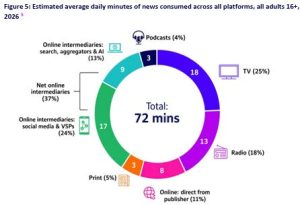
Ofcom’s News Consumption in the UK 2026 report lays bare a paradox. News consumption is near universal, but the routes by which people encounter it are multiplying and fragmenting. UK adults use around 12 news sources in an average month, rising to 18 among 25-to-34-year-olds. Online sources reached 82% of adults, while 73% used intermediaries such as social media, video-sharing platforms, search engines, aggregators and AI tools. Of the estimated 72 minutes adults spend with news each day, 34 minutes are now spent online.
Those figures describe plentiful access, not necessarily adequate journalism. Platforms are efficient at distributing what already exists; they cannot commission a reporter to sit through a council meeting, examine a health board’s performance or explain how a Senedd Bill will affect renters, farmers or families. Algorithms can surface a story, but they cannot compensate for a story that was never reported.
Ofcom also found that social and video platforms are increasingly central to discovery, especially for younger people, while trust remains strongest in traditional broadcast, radio and print news. AI has become another gateway: 21% of adults said they had used an AI service to access news in the previous month, even as 56% said they would trust an AI-written story less than one written by a person. Wales therefore faces a double vulnerability: too little original reporting about Welsh public life, and a distribution system that can detach information from its source, context and accountability.
A nation of overlapping news deserts
The phrase “news desert” is often used for a town without a local newspaper. In Wales, it describes something broader: gaps at local, regional and national level that reinforce one another. Research has identified places where councils and other powerful institutions receive little routine coverage. The decline of print advertising and circulation has closed offices, reduced reporting staff and concentrated ownership. Digital growth has expanded potential reach, but online revenue has not replaced the money once available for sustained reporting.
The result is not total silence. Community groups, independent publishers, broadcasters, specialist sites, podcasts and newsletters do valuable work, in both Welsh and English. But scarcity cannot be mistaken for resilience. A couple of newsletters cannot routinely cover 22 local authorities, seven health boards, the Senedd, the courts, policing, education, culture, the economy and the environment. Nor should citizens be expected to assemble a dependable civic picture from scattered posts, partial updates and whatever an algorithm decides to place in front of them.
A functioning news system needs redundancy: several organisations asking different questions, reporters with specialist knowledge, editors able to verify claims, and outlets capable of reaching people who do not already follow politics. Without that depth, press releases become news by default, misinformation travels with less resistance and public bodies face fewer informed challenges.
Being informed should not be a scavenger hunt
The democratic cost is cumulative. People cannot judge whether services are improving if performance is not independently examined. They cannot meaningfully engage with devolved politics if Welsh decisions are confused with English policy. They cannot hold representatives to account if basic facts arrive late, sporadically or stripped of context. Low awareness can then be misread as apathy, when it may reflect a rational response to an information environment that makes civic understanding unnecessarily difficult.
Repair will require more than hoping another small website survives. Wales needs long-term investment in independent public-interest journalism; fair access to public advertising and statutory notices; support for community and not-for-profit newsrooms; stronger routes into journalism across the country; and a settlement that serves audiences in Welsh and English. Funding must protect editorial independence, reward original reporting and support collaboration without forcing every outlet into the same mould.
Ofcom’s 2026 findings should end any comforting idea that the market’s multiplication of sources has solved the problem. Distribution is abundant; verified, Wales-focused reporting is not. A nation cannot remain reliably informed about the forces shaping everyday life through a patchwork of overstretched outlets and occasional interventions. Wales does not need less choice. It needs the underlying capacity to ensure that, wherever people encounter their news, there is enough journalism about Wales for them to find.